Newsletter Subscribe
Enter your email address below and subscribe to our newsletter

 ByJohn A
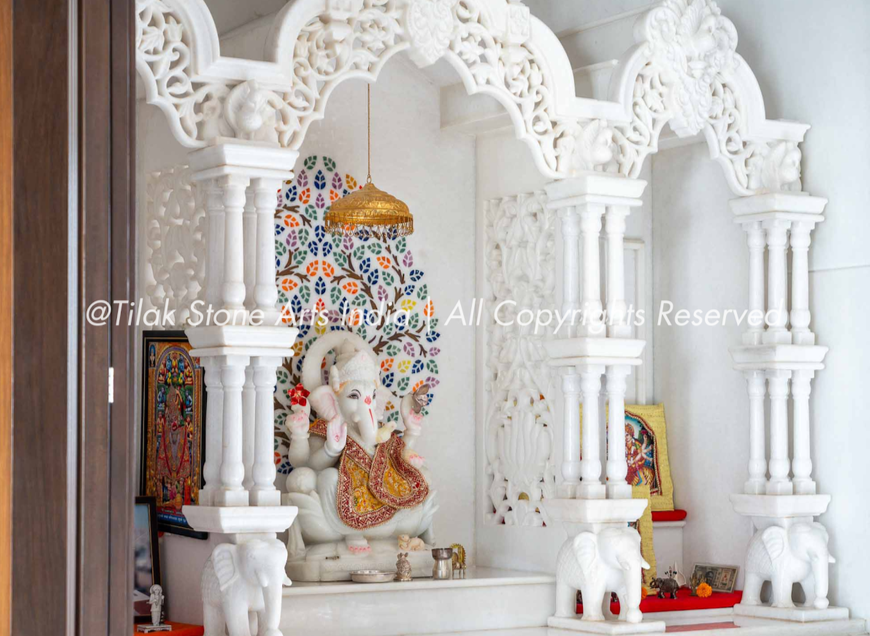
Most people choose a marble mandir for their home based on how the carving looks up close. The jali panels get treated as decoration, a pretty lattice behind the Deity. That reading misses what those screens actually do. Pierced stone controls how light enters the shrine, how smoke leaves it, and how the whole space feels at six in the morning versus nine at night. Get the Jali wrong, and you end up with a beautiful temple that stays dark, stuffy, and slightly disappointing every single day.
Here is why the panels matter more than their looks suggest. A jali is a working element borrowed from temple and palace architecture, where pierced screens managed daylight and airflow long before electric lighting existed. That same physics applies inside a marble mandir for home, just at a smaller scale. The holes do the work. The pattern around them is secondary.
Think about what happens in a closed mandir with solid back panels. Lamp smoke has nowhere to go. Camphor residue settles on the deity and the inner walls. The air feels heavy within minutes of starting aarti.
Now put a pierced screen at the back or sides. Warm air rises, exits through the openings, and pulls cooler air in from below. That gentle movement clears smoke without a fan.
Light behaves differently too. Solid marble blocks it completely. A jali breaks incoming light into small beams that scatter across the interior surfaces. The shrine glows softly instead of sitting in shadow.
Three separate jobs, one element:
This is the part nobody explains at the point of sale.
Small, tightly spaced holes give you fine detail and a delicate look. They also restrict airflow badly. Smoke lingers. Dust clogs them within a year, and cleaning becomes tedious.
Large openings breathe well and stay clean. They can look coarse if the surrounding pattern is not carved with care.
The ratio of open area to solid stone determines the outcome. Roughly a third open tends to work well for a home shrine. Below a quarter and the screen turns decorative rather than functional.
That may sound overly precise. In practice, you can judge it by eye. Hold the panel up to a window. If you see a clear glow through it, air will move through it too.
Jali carving is punishing on stone. You are removing most of the material and leaving thin bars behind, sometimes only a few millimetres thick.
Coarse or fault-prone marble snaps at exactly those bars. An artisan can lose an entire panel in the last few cuts. That risk pushes workshops toward thicker, clumsier lattices.
White Vietnam marble, also known as Swiss white marble or super-fine white Vietnam marble, has a tight, even crystal structure. Fewer internal faults mean thinner bars survive the carving. You get finer openwork without fragility.
The whiteness matters for light too. Pale, dense stone bounces light around the inside of the shrine. Darker or heavily veined stone absorbs it, and the interior stays dim no matter how open the screen is.
There is a small trade nobody mentions. Thinner jali bars look wonderful and need a gentler hand during cleaning.
Placement decides whether the screen works or sits there.
A mandir tucked into an interior corner gets almost no daylight. In that case, the jali still helps airflow, and backlighting behind the panel does the visual work instead.
Ask yourself where the temple will actually stand before choosing panel positions. That answer changes the design more than any carving preference.
See also: 5 Types Of Garments That Should Always Be Entrusted To Dry Cleaning Services In Dubai
Ask the workshop what percentage of the panel is open. If nobody can answer, that tells you the screens were treated as decoration rather than design.
Ask about stone as well. For a carved mandir, white Vietnam marble and its variants take fine jali work reliably. Pooja rooms allow a wider range of materials, including Indian wonder white marble, various Italian marbles, and onyx, because flat wall panels face no stress like a pierced screen does.
Then ask to see a jali panel held against daylight. Two minutes of looking tells you more than an hour of description.